
The Gunslinger and the Old Woman
Late one afternoon, when the sun was low and the dust floated in the air like powdered gold, an old woman rode her pack mule into a frontier town. She tied the animal to a hitching post, brushed the trail dust from her clothes, and stretched her back the way old bones do after too many miles.

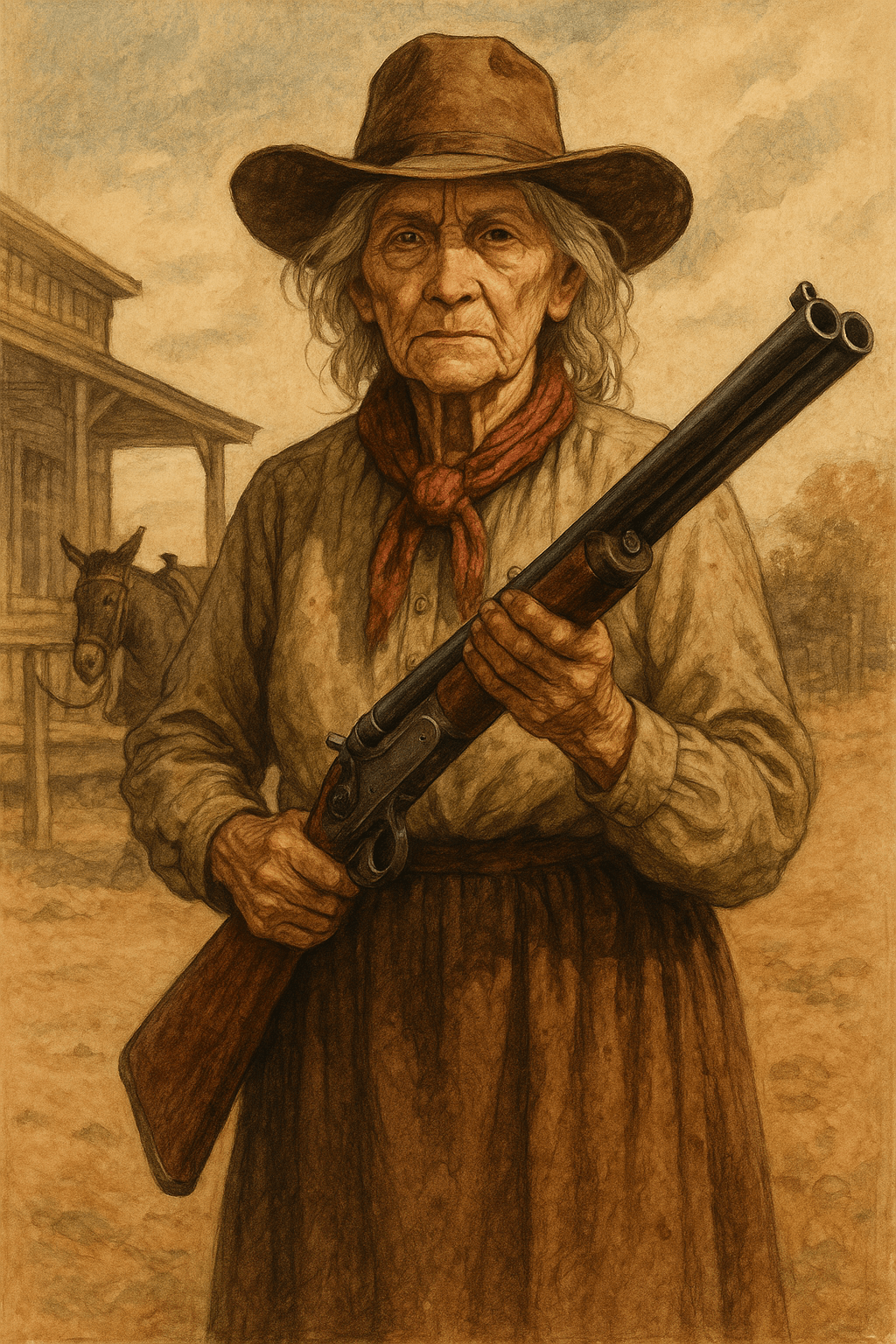
Late one afternoon, when the sun was hanging low and the dust floated in the air like powdered gold, an old woman rode her pack mule into a frontier town. She tied the animal to a hitching post outside the saloon, brushed the trail dust from her clothes, and stretched her back the way old bones do after too many miles.
Dancing
She had just finished when the saloon doors banged open and out swaggered a young gunslinger — half drunk, half full of himself, and fully convinced the world revolved around his boots. He had a gun in one hand, a bottle of whiskey in the other, and the grin of a fool who hasn’t met consequences yet.
Seeing the old woman, he laughed loud enough to draw a crowd.
“Hey, old woman! You ever dance?”
She looked at him evenly. “No. Never cared to.”
“Well, you’re gonna dance now,” he said, and he fired at the ground near her feet.
The bullets kicked up dust. The old woman hopped and dodged, not wanting to lose a toe. The watching crowd roared with laughter, enjoying the show at her expense. The gunslinger kept firing until his last round was gone, then holstered his weapon with a swagger and turned back toward the saloon.
What he didn’t notice — what nobody noticed until it was too late — was the old woman reaching into her saddlebag.
She pulled out a double-barreled shotgun. She cocked both hammers.
The click of steel echoed through the street like a sermon.
She pulled out a double-barreled shotgun. She cocked both hammers.
The click of steel echoed through the street like a sermon.
The laughter died instantly.
The gunslinger froze, then turned around slowly. He found himself staring down twin barrels as wide as the holes in his own common sense. The old woman’s hands didn’t shake. Her aim didn’t waver.
“Son,” she said quietly, “you ever kissed a mule’s ass?”
The gunslinger swallowed hard. “No, ma’am… but I’ve always wanted to.”
Five Lessons
- Never be arrogant.
Arrogance is what happens when confidence rots. The gunslinger wasn’t bold — he was blind. Real strength doesn’t need to parade itself, and real wisdom knows better than to assume someone else is harmless because they’re old, quiet, or minding their own business. - Don’t waste ammunition.
Literally and metaphorically. Every shot you fire — every word, every action, every choice — should matter. The gunslinger blew through his rounds trying to impress a crowd. The old woman used exactly two, and she didn’t even have to pull the trigger. - Whiskey makes you think you’re smarter than you are.
Or more charming, more invincible, more right. Anything that dulls your faculties — alcohol, ego, or the cheering crowd — will talk you into bad decisions and leave you standing in front of a shotgun wishing you’d made different ones. - Always know who really holds the power.
It’s rarely the loudest person in the room. Power sits quietly, watches carefully, and acts deliberately. The old woman didn’t raise her voice, boast, or draw attention. But she was the one who walked into town prepared. - Don’t mess with old women; they didn’t get old by being stupid.
Survival is its own credential. Anyone who has lived long enough to grow old has already outlasted danger, hardship, and fools. Respect the people who have seen things you haven’t — they carry tools, skills, and stories that don’t always show until needed.
A Short Biography of Mae "Dusty" Calder
Mae Calder wasn’t born tough — she was forged that way.
She arrived in the Wyoming Territory in the spring of 1847, a girl of fourteen with a sick mother, a brooding father, and a wagon full of bad luck. By the time she was twenty, she had buried both parents, survived a blizzard that killed half the settlement, and learned to shoot by necessity rather than pride.
Folks called her Dusty, not because she was unkempt — far from it — but because wherever she went, trouble tended to follow her like a dust devil on the prairie.
She married once, briefly, to a kind-eyed prospector named Calder who died in a mine collapse after their second year together. She kept his name because it reminded her of the only man who’d ever treated her as an equal and not as an ornament.
Mae never remarried. She also never softened.
She earned a reputation as the woman who could fix a broken wagon axle with a hammer and a curse, cook a rabbit stew that made grown men weep, and stare down a coyote, a drunk, or a debt collector with the exact same expression: calm, unimpressed, and unafraid.
Over the years she hauled freight, delivered mail through Apache country, and once midwifed twins on a stormy night when the doctor’s horse went lame. She asked no payment beyond a pot of coffee.
Her shotgun — the one in the picture — was a gift from an old trapper who said, “You ought to have something that matches your personality.” She accepted it with a nod; she never was one to waste words.
By the time she was in her late sixties, younger men in saloons still made the mistake of assuming she was frail.
She wasn’t.
She was seasoned.
And seasoning, as every frontier cook knows, is what makes something worth tasting.
Mae “Dusty” Calder lived out her final years on a small homestead outside Laramie, tending a stubborn mule, a few chickens, and whatever wanderers fate sent her way. Those who met her spoke of the same feeling — that she carried inside her the quiet authority of someone who had survived too much to be impressed by foolishness.
If you were respectful, she’d feed you.
If you were rude, she’d ignore you.
If you were dangerous, she’d deal with it.
And if you were smart, you’d listen — because buried beneath that weathered face and iron steadiness were stories no man had the courage to write down and few had the privilege to hear.
Credit Where Due
This is pure fiction of course. It was inspired by a LinkedIn posting I saw by Christine De Beer, who I follow mainly because of stories like this. Christine has the same first name as my Paternal Grandmother, so maybe that's the connection I see between these two women. My Grandmother had a strong personality, the same way Christine De Beer has today. Christine De Beer lists her location as South Africa.
I gave the original story to ChatGPT and asked to have it expanded a bit. The result is what you see above, that I have not altered—not even a jot or tittle.
ChatGPT then offered to create the short bio of Mae "Dusty" Calder (a name it invented somehow) and again, the unaltered result is what you see above.
And finally, I asked for an illustration, that you see as the banner image on this post.
My own contribution in this case is:
- This section titled "Credit Where Due"
- Formatting, adding topic headers, and pull-quotes
- Organizing it all into a blog post along with Google SOA information
- Mailing it to my list of subscribers
Hope everyone has a great Thanksgiving and Holiday season.
With agape[1] as the Greeks might say, take the time to enjoy your friends, family and other human connections as you enjoy this digital piece of entertainment.
Happy Holidays
Milan
Love
Selfless and unconditional: This is the most common meaning, describing a love that is not based on personal feelings or the merits of the other person, but is a choice to seek the well-being of others, even enemies.
Christian context: It is considered the highest form of love, a "godly" or "Jesus-like" love, famously demonstrated by God sending his son, Jesus, for humanity.
Action-oriented: It is not just a feeling, but a volitional act of love that is put into action. ↩︎