Of Pachyderms and Night Hawks
The Theater Wit lobby on a weekend is probably one of the best people-watching venues in Chicago; it's a parade of the wide variety of ages, ethnicities, and economic levels and a never-ending source of curiosity for me.

Last Saturday I decided it was time to see another play. I chose The Elephant Man being presented at Theater Wit on Belmont Avenue in Chicago. It's probably my favorite venue for Chicago Storefront Theater, and one in which I've spent many enjoyable evenings.
Getting There
My customary travel to Theater Wit these days is via walking and the CTA Brown Line. I walk from home to the Damen Avenue Brown Line stop. Hop a train toward downtown Chicago, and get off at the Southport stop. From there I walk over to Belmont and Racine to the theater complex, housed in a former US Post Office building and hosting three theaters of about 100 seats each.
The Theater Wit lobby on a weekend is probably one of the best people-watching venues in Chicago; it's a parade of the wide variety of ages, ethnicities, and economic levels and a never-ending source of curiosity for me. Last Saturday was no exception.
- One younger man exhibited many of the characteristics of the construction worker of The Village People: macho, well muscled, carefully groomed perma-stubble, denim very-short shorts, boots. What wasn't so characteristic of a construction worker was the brilliantly sequined evening bag hung over one shoulder by a long, sequined strap. He was also clutching a large bouquet of roses. I saw him at the beginning of the evening, and as I left to go home, still with his shoulder bag and roses in hand.
- An older woman who claimed to be in her 80s, wearing an upscale, hot-pink jacket and skirt combination that set off her white floral print blouse and matching pink neck scarf, was animatedly conversing and entertaining the couple seated next to me at one of the cocktail tables in the lobby. She was excitedly and vocally telling all who would listen about her recent adventures and determination to stay active and engaged socially for as long as possible. When she noticed my enjoyment and broad grin inspired by her narrative, she laughed and pointed to me, wondering aloud if I was amused by her performance as a meshugenah. She had driven all the way from the Northern suburb of Deerfield to attend the performance of A People, "a magical, lyrical journey into heritage, tradition, religion and humanity, through a Jewish lens."
The Elephant Man — The Play
The Elephant Man by Bernard Pomerance premiered in 1977 at the Hampstead Theatre, London. It is based on the difficult life of the real person named Joseph "John" Merrick, (b. 1862 – d. 1890). There is only the hint of a plot, instead being an episodic depiction of events occurring during the last six years of Merrick's life.
Merrick suffered from a rare disease that left him grossly disfigured; his limbs were enlarged, he had a large bony bump on his massive head, his skin hung loosely in sack-like folds that covered his back, and a small growth on his upper lip gave rise to his more widely known name as "The Elephant Man".
Merrick was encountered by surgeon Dr. Frederick Treves, also a real person, who removed Merrick from the freak show where he was employed and given housing in the London Hospital, supported by charitable donations. Merrick ultimately died while living in remodeled rooms in the hospital basement.
What It's About
Pomerance's play is generally presented as a critique of Victorian hypocrisy. After being "rescued" by Treves, Merrick becomes the darling of London's wealthy and influential, entertaining many visitors and notables of London high society. According to some accounts, despite being housed and supported with charitable donations he was actually constantly on display for wealthy and important visitors who, similarly to the masses who attended freak shows, came to visit Merrick out of a prurient fascination with Merrick's disfigured body rather than to "cheer his confined existence."
The play depicts these exchanges with various visitors ranging from royalty to important clergy. All seem to have their own best interests in mind rather than the needs of Merrick. All, that is, with one exception.
The Performance
The character Mrs. Kendal (Katherine Schwartz), an actress, is at first hesitant and repulsed by Merrick's appearance, but soon discovers shared interests and appreciation of art, theater, spirituality and beauty. It is one of the best scenes in the entire play, and drives its point home in a gentle yet unmistakably direct conversation.
Special mention also goes to Tony Calkins portrayal of Frederick Treves. Treves serves as a costar and proxy for Victorian sensibilities in a convincing and authentically hubristic manner.
Billy Surges's portrayal of the difficult Merrick character was poignant and convincing. Playwright Pomerance insisted that the role be performed without the aid of prostheses, relying instead on posture, facial expression, and movement to depict Merrick's physical condition. Achieving this illusion in a way that includes the audience's imagination on the journey is no easy task, but one that was well executed by Surges's presentation.
Theatrically, the performance I saw was excellent. The set was sparse, in keeping with the playwright's intentions, yet we clearly understood the setting and circumstance of each of the 21 different scenes. Likewise, Direction by Conor Frank was capable and secure.
Production
What impressed me most was the ambition of the production. Looking through the credits, it quickly became apparent that a small group of people were wearing multiple hats—acting, directing, designing, constructing sets, running technical elements, and handling backstage responsibilities. Such multitasking is characteristic of storefront theater, where a handful of dedicated individuals often make the entire enterprise possible.
That commitment showed. Despite modest resources, the production successfully navigated twenty-one separate scenes, a challenging central performance, live incidental music, and a thoughtfully executed visual design. The result felt considerably larger than one might expect from a company of this size.
Music
It was a treat to have live musicians adding a special touch to the entire performance. Joey Calumet's Piano and Supervision was ably augmented by Lukas Placek's viola. The viola's distinctive timbre added a marked note of somber dignity to the performance.
Frankly, we need more acoustic instruments and live musicians providing incidental music for theatrical productions. Music can often convey in a few well-played bars what might take precious minutes of time to convey on stage.
The presence of Calumet and Placek made a lasting impression on my memory of this production.
The Message
The play is clearly concerned with the way in which humans in general perceive and interact with those who are not part of mainstream society for various reasons: preference, accident, disease or inherited or chronic disorder. In particular, it portrays either the ostracism or prurient interest in the extreme forms of nonconforming, the so-called freaks of nature.
Victorian Hypocrisy
The playwright uses the Merrick case, fairly well documented in medical journals of the period, to illustrate Victorian Hypocrisy:
- Rigid moral rules
- Public respectability
Contrasted with
- Dark, hidden truths
- Masked exploitation
- Vice
- Double standards
Other examples of a similar unmasking include:
- Oscar Wilde's The Importance of Being Earnest
- Lewis Carroll's Alice in Wonderland
- Thomas Hardy's Tess of the d'Urbervilles
- Lord Holden's Purgatory Revisited
- W.S. Gilbert and Arthur Sullivan's Pirates of Penzance
Other Views
Audiences often interpret The Elephant Man as a story involving an unfortunate accident of nature (Joseph Merrick) and his hero savior (Dr. Frederick Treves), who ultimately begins to question his own Victorian standards and becomes unsure of his own part in the Merrick episode. Treves discovers the incongruity of his beliefs governing behavior and societal belonging contrasted with freedom and dignity.[1]
A somewhat harsher view is held by Nadja Durbach in her essay Re-examining "the Elephant Man".[2] Durbach reports that according to other accounts, Merrick was, in fact, "put on display" at the London Hospital and became dependent on charity for his existence. This is in contrast to Merrick's previous life of freedom to earn his own subsistence by selling his services to producers of freak shows. In short, it deprived Merrick of his agency in the service of charitable activity by Treves and others.
In the final analysis, there is no definite answer to either position. For those who value agency over comfort the choice is likely to be freedom to become a public exhibit. For those who favor traditional charity, private support with loss of agency may be preferable.
But it is important to realize that the choice is not necessarily obvious and depends a great deal on circumstance and the attitudes and beliefs of the individual involved.
Reconciling
The Elephant Man doesn't provide clear answers to many questions. It does provide many important questions:
- What truly defines "normal?" Are standards of normalcy arbitrary and cruel?
- Who are the true "freaks?" Are those who gawk at Merrick more likely to be the true freaks? And, we might ask, is the audience who attends a performance of a play about Merrick any different from Victorian audiences visiting a freak show?
- Is there cruelty in charity? It was, after all, charity that took Merrick and confined him an a controlled environment, putting him essentially on display.
- What does humanity owe the vulnerable? How can we treat marginalized individuals with true respect?
Songwriter friend Brian Hutzell provides a glimpse into the complications of respect and friendship with this lyric:
Oceans Apart
Music © Kevin Dempsey 1994
Lyrics © Brian Hutzell 1994
•
I listen to your stories
Your friends are more familiar to me than my own
I’ve lived a longer life but I have less to show
Still, I'm so very thankful we can talk
Even if we only talk of nothing
You’re my friend and you stand by me
But I know, deep in my heart, we’re oceans apart
I can depend on your empathy
But I know, deep in my heart, we’re oceans apart
•
You ease my worries
It’s comforting to know I’m special to someone
And that the cards I’ve sent won’t soon be forgotten
Our lives are facing different directions
It’s a miracle we ever met at all
We do not belong together
We’d fail any compatibility test
But you’re there in the foulest of weather
So I’d be a fool to protest
Your lifestyle makes me wince
Your opinions don’t convince
I disagree with you on nearly every point but since..
You’re my friend, you can count on me
Though I know, deep in my heart, we’re oceans apart
You can depend on my empathy
Though I know, deep in my heart, we’re oceans apart
Going Home
Going home was the reverse of attending the show. Walk to the Brown Line station at Southport. It was by now nearly 10:30 PM and foot and car traffic on Southport was diminished to a fraction of what it was when I arrived.
Coco
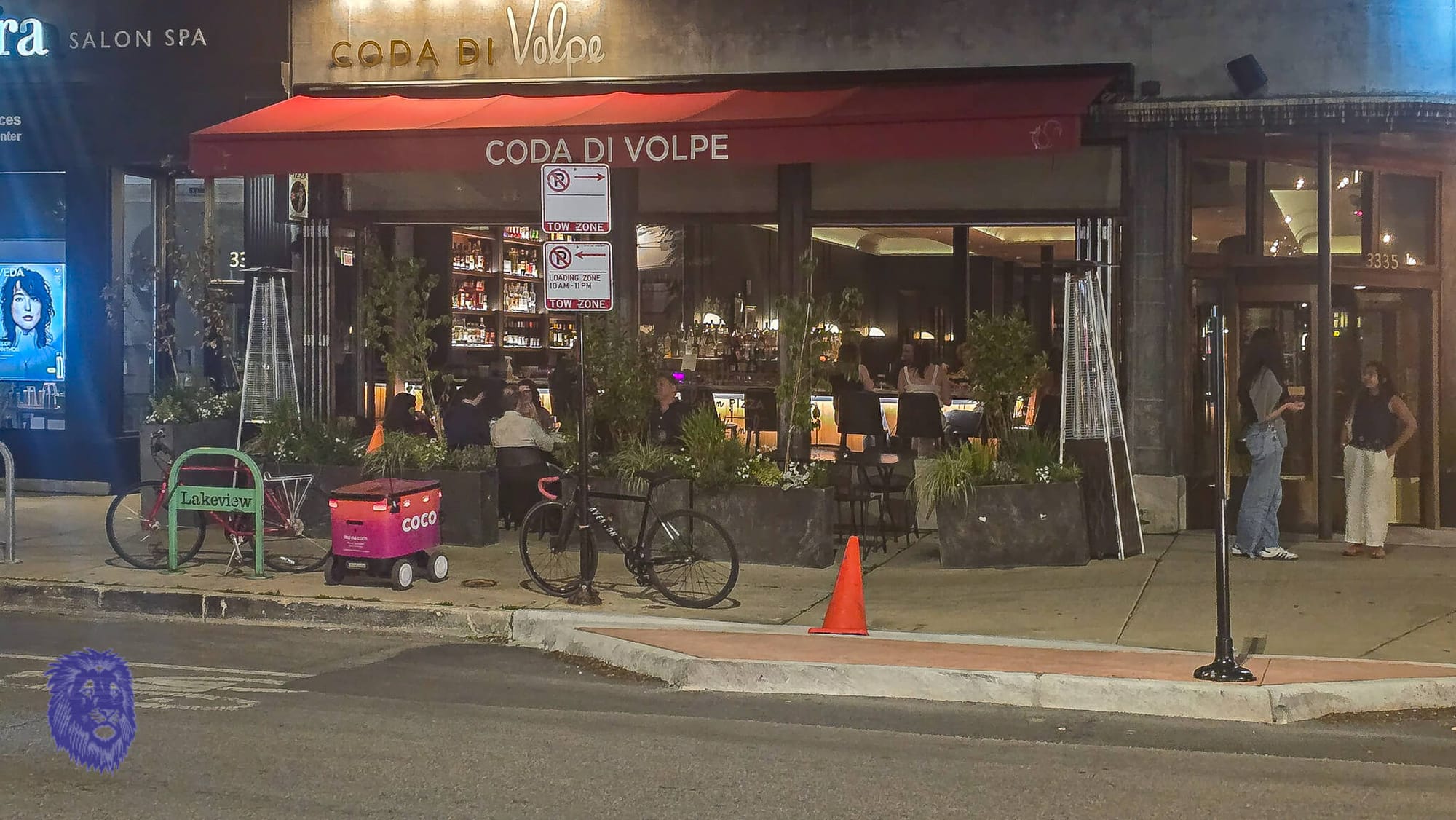
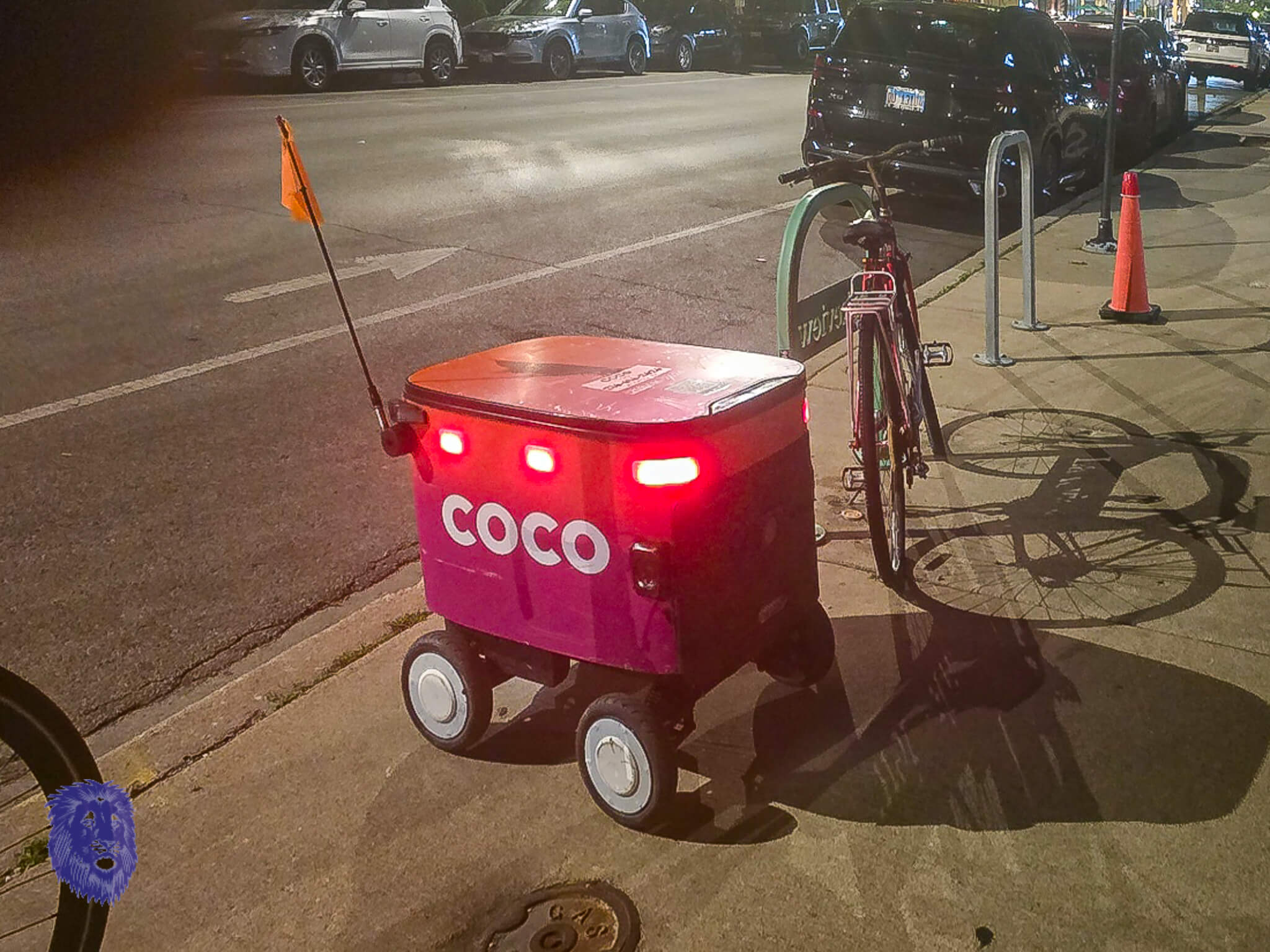
As I passed Coda de Volpe on Southport, I noticed Coco, the robotic delivery vehicle that now plies the street of Chicago's North side as well as Los Angeles, Miami, and Helsinki. Coco was waiting patiently outside of Coda de Volpe for a delivery.
The Brown Line
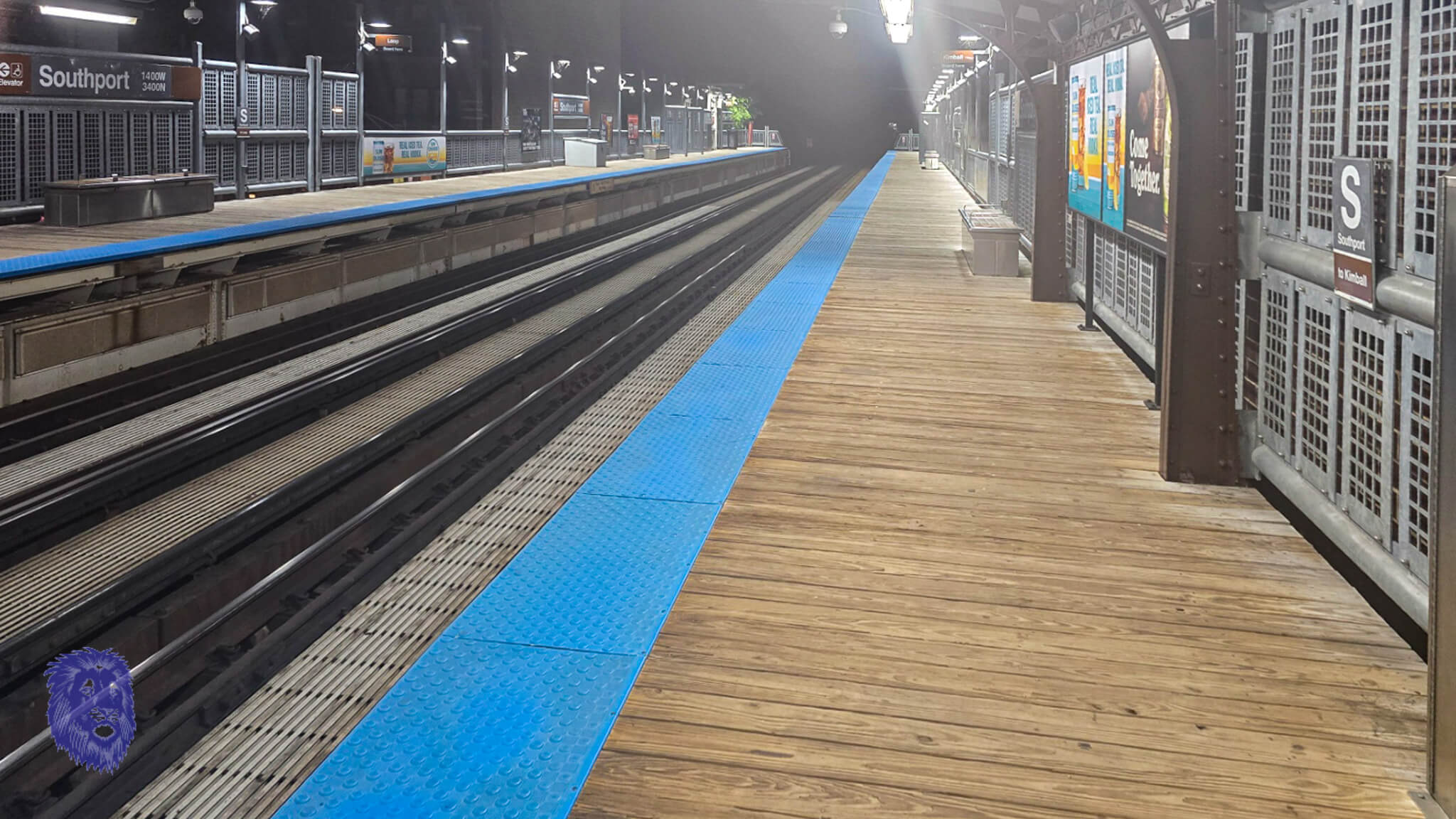
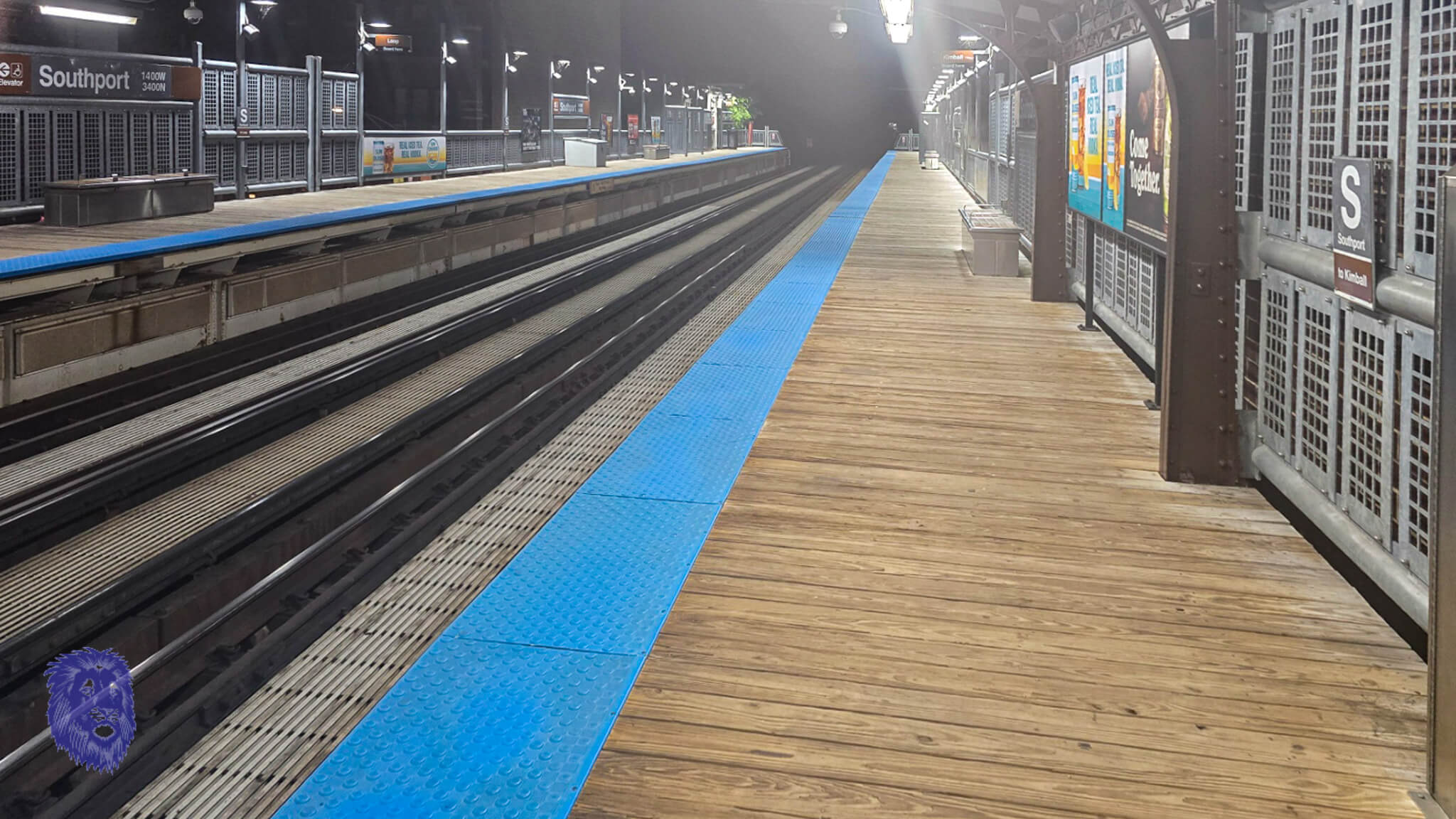
Just as Coda de Volpe was busy, so the Brown Line station at Southport was deserted. Nothing to see here, except empty space. So I waited, but only about seven minutes for the next train.
The train, on the other hand, was pretty well occupied with late-night people returning or going somewhere, often just getting home after a long day on the job. I scanned the car I was riding; an older couple sat in stony silence, resembling Grant Wood's well known painting, American Gothic. Several others scrolled aimlessly on their cell phones. A group of younger women chattered like chipmunks over what was an apparently satisfying evening out with the girls. Once again songwriter Hutzell captures the scene.
On The Bus
© Brian Hutzell 1990
•
Two men, the old and the young
The red-haired girl who’s ignoring everyone
The tall blonde athlete falling asleep
The young teenager sitting still in his seat
The couple in the back seat going out to dance
In their loose fitting shirts and their leather pants
The couple up front throwing Faulkner back and forth
Finally agreeing on Whitman’s worth
The crowd coming on in their rush to get home
All on the bus together, all traveling alone
Platform 47
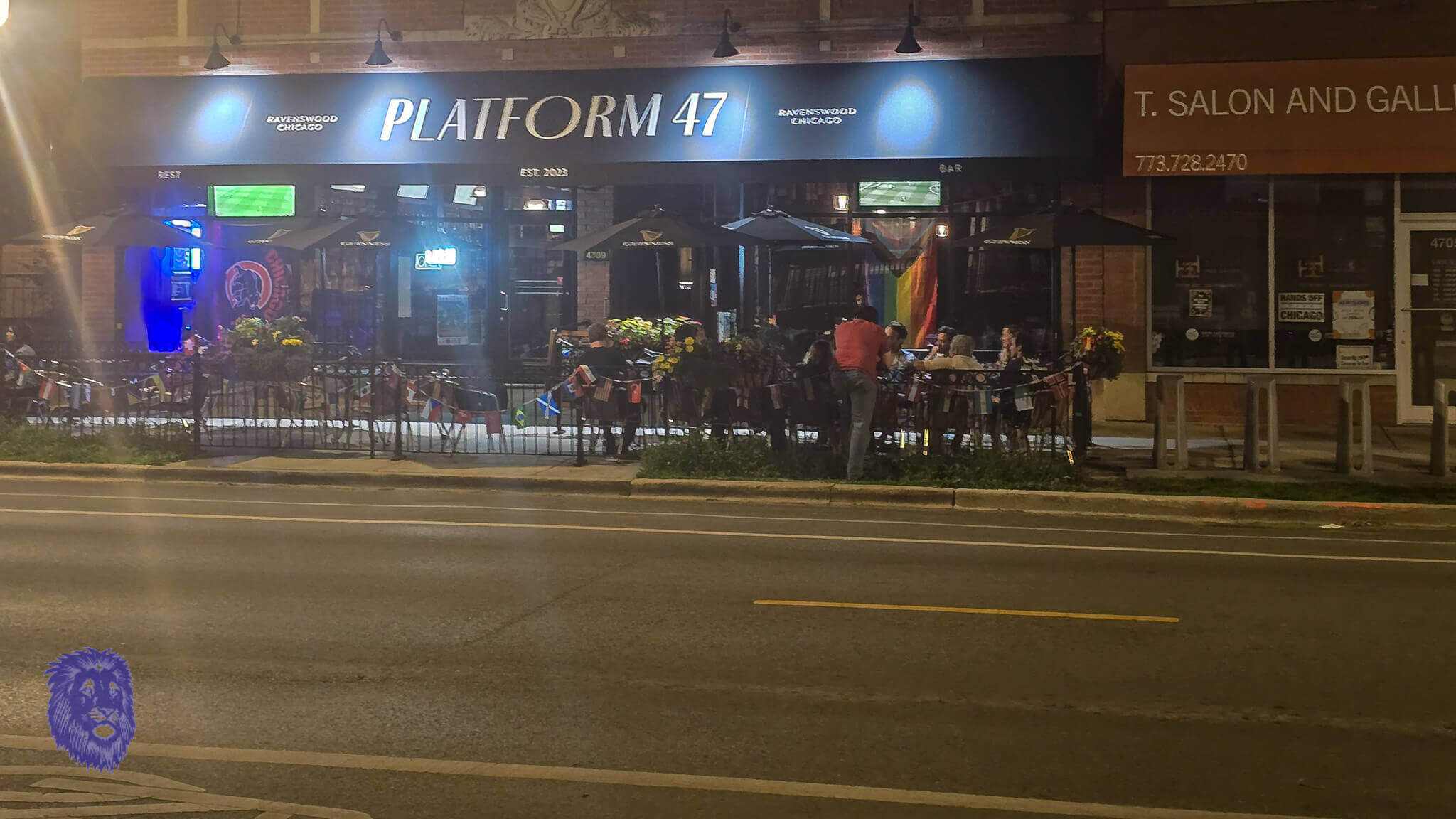
Southport, Paulina, Addison, Irving Park, Montrose, Damen. The train makes swift progress and I get off and walk downstairs to Damen Avenue for the walk home. As I pass Platform 47 the restaurant near the Damen stop, I hear the boistrous laughter and conversation of a group of men sitting on the patio adjacent to the street. Soon, it will be 11:00 PM and because of city ordinance, the waitress will be shooing them indoors to avoid disturbing the still of the night. At Platform 47, no Coco sits waiting.
Dave
Just as I'm about to turn the corner and leave Damen Avenue to walk up Farragut Avenue and my apartment, I notice Dave, "The Mayor of Bowmanville" (my name for him.) He knows and sees everything noteworthy that happens within three blocks in all directions of his store-front garden apartment on the corner.
I stop, and we talk about the latest transgressions he has observed on the street: the teens who drive a vehicle with a loud muffler but no tail light up and down Damen, late at night; the motor scooter driver who routinely runs all stop signs on Damen Avenue; the new yoga parlor that has just moved in a few doors away; the tattoo parlor that closed up to the north because their work was so terrible nobody wanted to trust them with a permanent addition to their epidermis.
After collecting the juiciest of the gossip, I bid goodnight and turn the corner to home.
Home
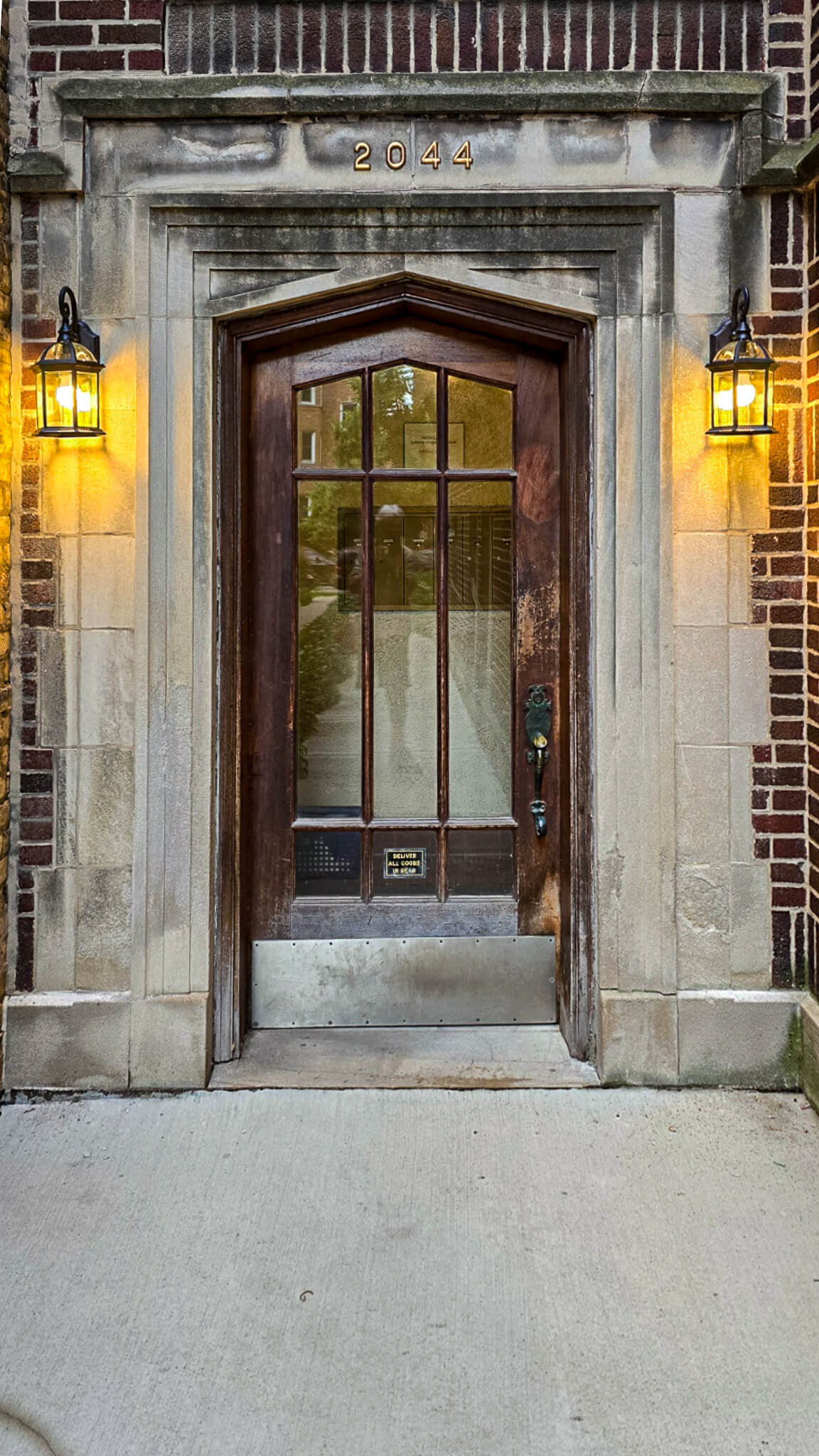
I finally arrive at my front door, happy to be back on familiar turf after an interesting evening.
- People watching at Theater Wit
- Contemplating individuality and the meaning of charity
- Bumping into Coco
- Watching crowded late-night diners at two popular restaurants
- Experiencing the loneliness of a Brown Line platform as the only passenger waiting
- Experiencing the loneliness of a Brown Line train, moderately crowded with passengers all traveling alone
- Gossiping with the Mayor of Bowmanville
- Seeing the warm glow of the lights at my own front door
- Being grateful that I have spent another day on the great journey of life, learning what I can, and enjoying what I learn
Why Does The Rain?
Music © Kevin Dempsey 1996
Lyrics © Brian Hutzell 1996
•
Will there ever be a time when rainbows end
And flowers in the wind refuse to bend?
Will I wake up with no questions in my mind,
My curiosity completely satisfied?
I hope, I hope I never outgrow the sun
I hope, I hope I never stop having fun
Will I ever stop believing in my dreams,
Those reassuring possibilities?
Will I ever tire of tasting forbidden fruit?
Will I ever jump without a parachute?
I hope, I hope I never become too sane
And I hope, I hope I never stop wondering…
Why does the rain?
When the world says, “No,” I’ll be saying , “Yes!”
When there’s no clear way to go, you might as well guess
They can shoot me down forever if they want
But when forever’s done, I’ll get back up
I hope I never listen to my fears
I hope I keep finding new frontiers
I hope, I hope I never stop feeling pain
And I hope, I hope I never stop wondering…
Why does the rain?
In the spirit of Cavafy and Hutzell, may you all have a safe and enjoyable journey.